Test results
Getting your test results
If the Doctor feels you need to have some tests, they will give you clear instructions of how these will be arranged and dealt with.
You will usually be asked to attend the Community Treatment and Care Clinic (CTAC) for tests such as BP checks, blood tests and some injections.
The result of your test is an important part of your treatment and it is essential that it is handled safely. The GP requesting your test should be the GP to review the result, where possible.
If your test results show that you need more tests or treatment, the GP may request one of the admin team to contact you. As our admin team are non-clinical staff, they are unable to interpret your tests results and can only pass on the information or comment given by the GP.
Patients can call after 2pm to enquire about any test results.
Please note we will only give test results to the patient themselves unless that person has given prior permission for the release of this data or they are not capable of understanding the results.
Blood Tests
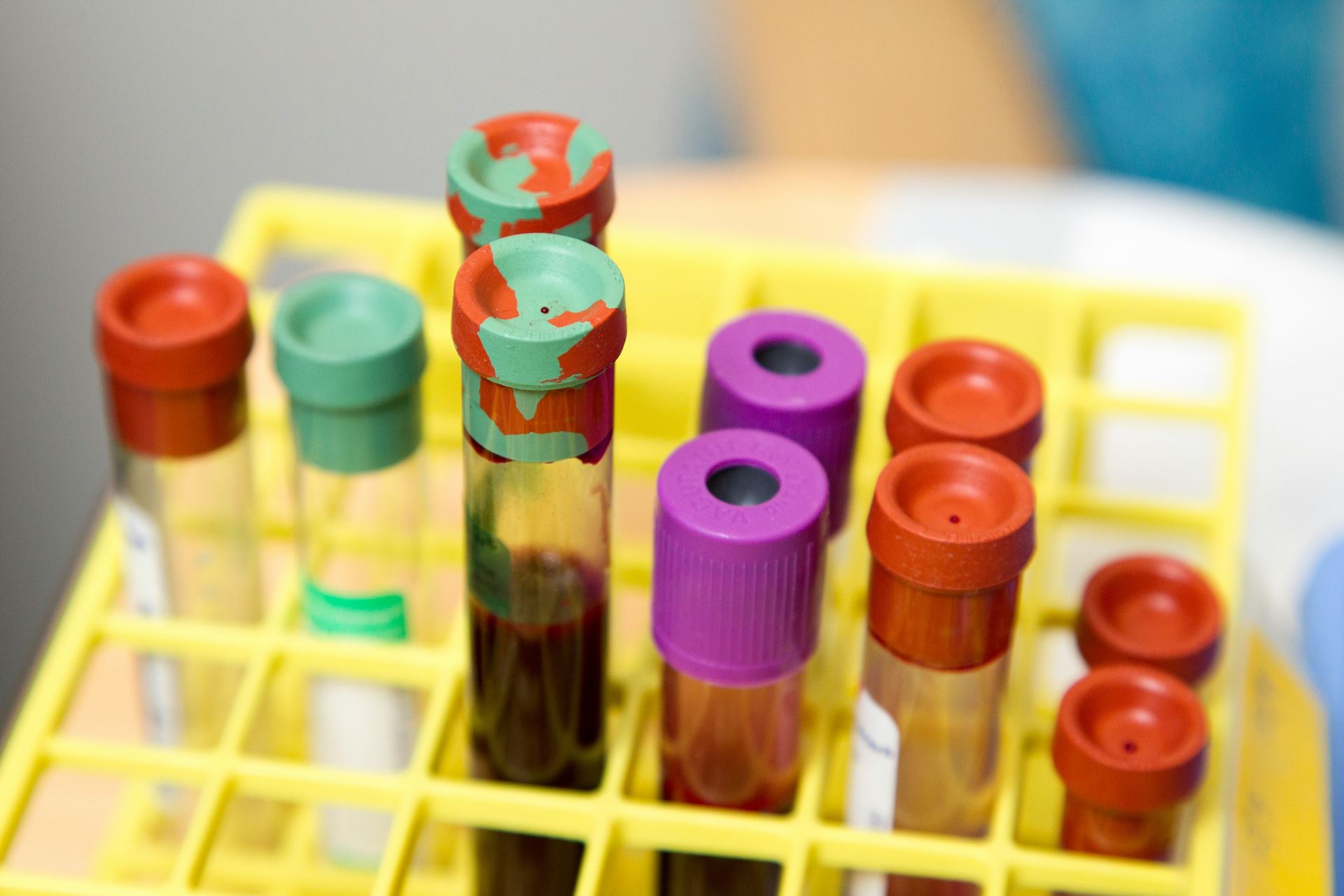
A blood test is when a sample of blood is taken for testing in a laboratory. Blood tests have a wide range of uses and are one of the most common types of medical test. For example, a blood test can be used to:
- assess your general state of health
- confirm the presence of a bacterial or viral infection
- see how well certain organs, such as the liver and kidneys, are functioning
A blood test usually involves the phlebotomist taking a blood sample from a blood vessel in your arm. and the usual place for a sample is the inside of the elbow or wrist, where the veins are relatively close to the surface. Blood samples from children are most commonly taken from the back of the hand. The child's hand will be anaesthetised (numbed) with a special cream before the sample is taken.
You can find out more about blood tests, their purpose and the way they are performed on the NHS Choices website.
Test Results
Results will be issued in person or over the telephone only after 14:00. We would ask that you allow one week before contacting the practice after your test. Please note that some results may take longer.
In order to maintain confidentiality test results and hospital reports will only be given to patients themselves, or to parents of minors if appropriate.
Please also be aware that the practice is not in a position to give results of tests arranged by the hospital, and hospital clinics should be contacted directly for these results.
X-Ray
An X-ray is a widely used diagnostic test to examine the inside of the body. X-rays are a very effective way of detecting problems with bones, such as fractures. They can also often identify problems with soft tissue, such as pneumonia or breast cancer.
If you have a X-ray, you will be asked to lie on a table or stand against a surface so that the part of your body being X-rayed is between the X-ray tube and the photographic plate.
An X-ray is usually carried out by a radiographer, a healthcare professional who specialises in using imaging technology, such as X-rays and ultrasound scanners.
You can find out more about x-ray tests, how they are performed, their function and the risks by visiting the NHS Choices website.
Urine Samples
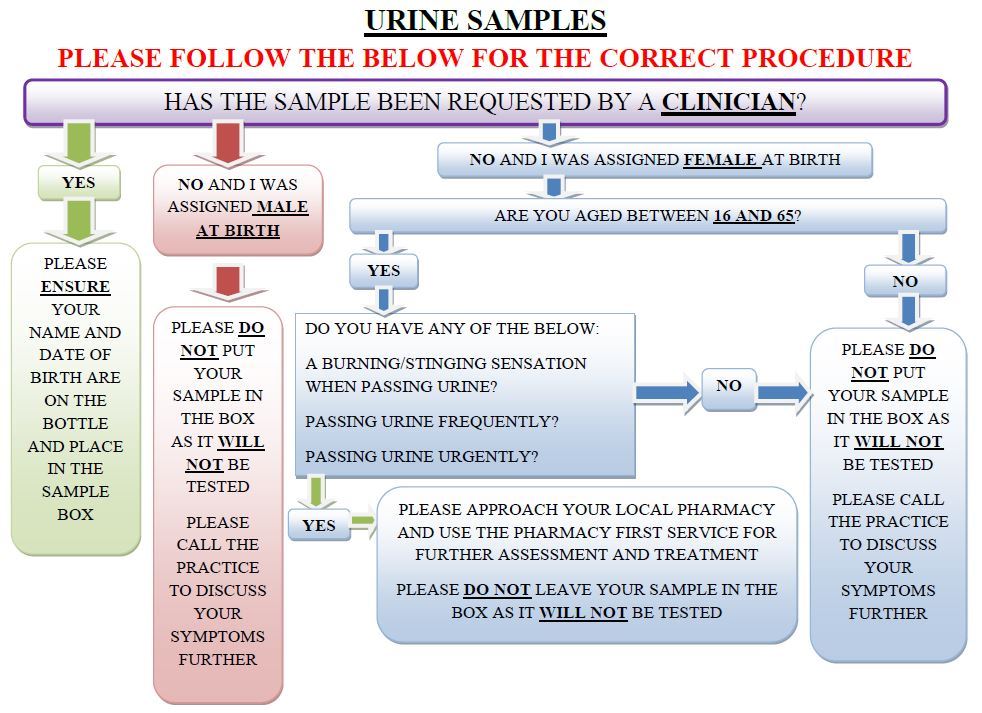
Urine samples should only be handed into the practice if the sample has been requested by a clinician.
Please follow the flowchart below for further information regarding urine samples.
Any urine sample not requested by a clinician will not be tested
HOSPITAL REQUESTED TEST RESULTS
If you are seen in the hospital as an inpatient, at an outpatient clinic or at A&E, you may have some tests, the results of which you will not get immediately. Understandably, patients often contact their GP practice, to try to get hold of these results.
However, we would not usually receive these. When a test is carried out, the result is returned to the doctor who requested the test. This means that when a hospital doctor orders a test, the result will go to them and only to them, and we may only find out about that result if they write to us.
Therefore, we do not chase hospital tests for three main reasons:
We often have no idea why a test was requested, nor what question the hospital doctor was trying to answer when they requested it, nor in more specialist cases, what should be done with a particular result.
Administratively, we are not informed when a hospital doctor requests tests, and therefore do not know they exist to chase; from a workload perspective, we are not funded or resourced to chase up tests ordered by hospitals.
The BMA (British Medical Association) agree that the “duty of care” in chasing test results rests with the person requesting the test, i.e. that if a doctor asks for a test they need to chase up and act on the result themselves.
For these reasons, please contact the hospital and ask for the secretary of the doctor who saw you. They can obtain the results, or let you know when and how you will receive them. Please try not to take up our receptionists’ time asking us to do this, as it is the hospital’s responsibility.
We are of course very happy to discuss your results with hospital doctors should they wish.
Page created: 08 November 2024